Public vs. Private 3-K and Pre-K in NYC: Real Pros and Cons
NYC gives you free public 3-K and Pre-K for All alongside private preschools that can run past $50,000 a year. A Family Life Educator walks through the pros and cons of each, what quality actually looks like and how to choose the right fit for your 3- or 4-year-old.
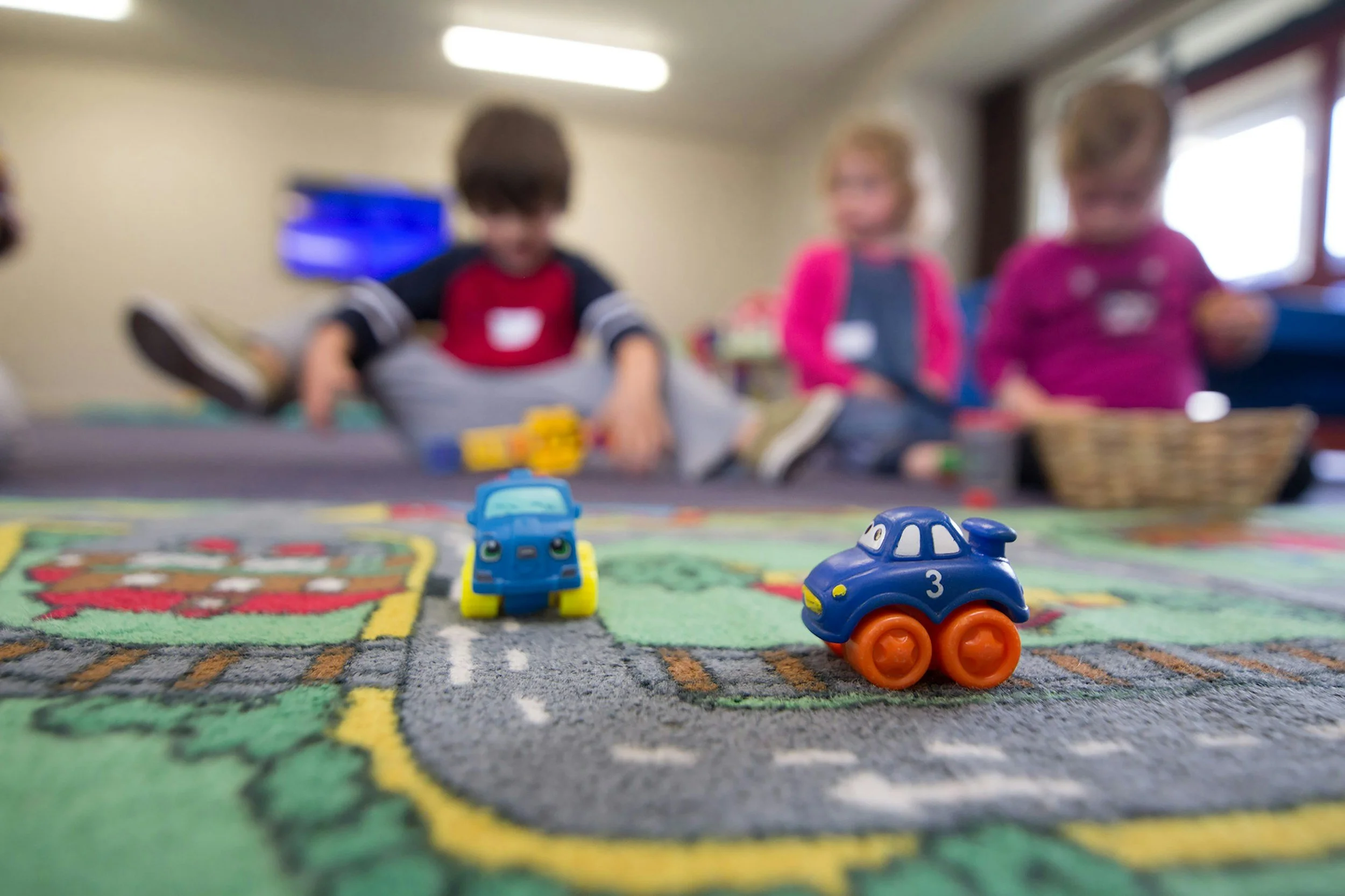
There are pros and cons of both city-ran programs and privately ran programs.
In New York City, the preschool years come with a fork in the road. You can send your 3- or 4-year-old to free, full-day public 3-K or Pre-K for All, or you can pay for a private preschool, where tuition in some neighborhoods rivals a year of college. Both paths can give your child a warm, play-filled start. The right one for your family depends on your budget, your schedule, where you live, your child's temperament and your plans for kindergarten.
This guide lays out how public and private programs actually work in NYC right now, the pros and cons of each and what high-quality early education looks like from a child development point of view.
What 3-K and Pre-K mean in NYC
The labels trip people up, so let's make them plain. 3-K is the city's free public program for 3-year-olds, and you apply in the calendar year your child turns 3. Pre-K, run as Pre-K for All, is the free public program for 4-year-olds, which is what some families mean when they say "4-K." For both, your child qualifies if they turn 3 or 4 by December 31 of that year.
Public 3-K and Pre-K run in two main settings, and this is the part most guides skip. Some seats sit inside district public schools. Many others sit in community-based NYC Early Education Centers, which are private organizations such as nonprofits, faith-based groups and nursery schools that contract with the Department of Education to offer free seats. Both kinds are free and follow the same DOE play-based curriculum. A private preschool, by contrast, sets its own tuition, its own philosophy and its own calendar.
Here's the wrinkle worth knowing: a single private preschool can also host free public 3-K or Pre-K seats as one of these community centers. The line between "public" and "private" blurs in practice, then, and the question often becomes whether a specific program has a free seat available, a paid tuition spot or both.
How public 3-K and Pre-K work in 2026
The headline is simple: full-day public 3-K and Pre-K are free. A standard "school day" seat covers 6 hours and 20 minutes, roughly September through June. Families who need more can look for an Extended Day and Year seat, which provides up to 10 hours of care a day, year-round, free or low-cost for families who qualify by income. You apply through the city's MySchools system, with applications that typically open in mid-January and close in late February and offers released in the spring. Your child has priority for programs in your home district.
Two facts shape the public picture right now. First, there is a Pre-K seat for every 4-year-old in the city, so Pre-K for All is close to a sure thing. Second, 3-K has historically run short in some neighborhoods. Under the prior administration, expansion stalled, and the city ended up with a mismatch: long waitlists in some ZIP codes and empty seats in others, with some families placed miles from home, as Gothamist has reported.
That is shifting. In 2026, with more than $1.2 billion in state funding from Governor Kathy Hochul, the city announced roughly 2,000 new 3-K seats across all five boroughs, a push toward universal 3-K and a new free 2-K program for 2-year-olds. The aim is to place families closer to home and widen access. For a parent deciding today, the takeaway is that free public options are expanding, and it pays to apply on time and use the waitlist if your first offer is not the right one. It matters because child care in NYC averages well over $20,000 a year.
Public 3-K and Pre-K: the pros and cons
For most families, free public 3-K and Pre-K are a strong, sensible choice. Here's the honest balance sheet.
Pros
It's free: a full-day seat costs your family nothing, which can save more than $20,000 a year compared with private care.
A full school day: 6 hours and 20 minutes of care covers a real chunk of the workday, and Extended Day seats stretch that to 10 hours for families who qualify.
A play-based, consistent curriculum: every setting follows the same DOE play-based program, with teacher standards and city oversight behind it.
A near-guarantee at age 4: Pre-K for All offers a seat to every 4-year-old in the city.
A neighborhood mix: public rooms tend to reflect the real community your child lives in, which is good for social learning.
Cons
No guaranteed 3-K seat everywhere: demand still outpaces seats in some neighborhoods, though the 2026 expansion is easing that.
A set schedule: the standard day runs 6 hours and 20 minutes, September through June, so full working-parent coverage means an Extended Day seat or add-on care.
You may not get your first pick: placement runs through an application and waitlist, and your closest program can fill up.
Quality varies by site: a city-wide curriculum still plays out differently room to room, so you have to visit and compare.
A big system moves slowly: applications, offers and communication can feel impersonal next to a small private program.
Private preschool: the pros and cons
Private preschool spans a huge range. Part-time and community programs can run from a few thousand dollars up to about $20,000 a year. Established full-day private preschools commonly land between $25,000 and $50,000, and at the very top, school-affiliated programs can pass $70,000. Avenues set its 2026-2027 tuition at $75,300 from age 2 on up, per Business Insider, and New York Family pegs a more typical full-day range around $25,000 to $30,000.
Pros
Flexible hours and start ages: many programs offer part-time schedules, longer days, year-round care and spots for 2-year-olds.
A philosophy you choose: you can pick Montessori, Reggio Emilia, play-based, language immersion or a faith-based program to match your family's values.
Small groups and continuity: some private programs hold low ratios and keep the same children and teachers together across the year.
A possible on-ramp to private kindergarten: for families aiming at independent schools, staying in that world can smooth the next round of admissions.
You choose directly: you apply to the program you want rather than waiting on a public placement.
Cons
The cost: tuition can rival college, and that is before fees, deposits and add-ons.
Competitive, early admissions: popular programs fill fast, with tours, applications and deposits due months ahead.
Price and quality don't always line up: a high tag buys prestige and amenities, and it can still sit alongside a so-so classroom, so judge the room itself.
A narrower mix in some programs: tuition can sort families by income, which thins out the economic and neighborhood diversity of a class.
What actually makes a preschool high quality
Here's the part that matters more than the public or private label. A free public room can be excellent, and a $50,000 program can be ordinary. What separates a great early-childhood classroom is the same in any setting, and the National Association for the Education of Young Children spells it out in the 10 standards behind its accreditation. Watch for these:
Small groups and low ratios: NAEYC recommends no more than 20 four-year-olds in a group with 2 teaching staff, which is about 1 adult for every 10 children or better. Fewer children per adult means more warm, individual attention.
Warm, qualified teachers: watch how the adults talk to children, get down to their level and follow their lead.
A play-based, developmentally appropriate day: at this age, play is the real curriculum. Our piece on why play-based learning works covers the evidence in depth.
A safe, language-rich space: look for clean, organized rooms full of books, materials and child-made work on the walls.
Accreditation or a strong review: NAEYC accreditation is a useful quality signal, public or private.
This holds up in the research. The American Academy of Pediatrics' clinical report The Power of Play, reaffirmed in 2025, found that play with responsive adults builds executive function and helps buffer young children against stress.
How to choose the right fit for your child and family
There's no single best answer, so work through the factors that actually decide it for your family.
Your budget: free public seats save real money, and if you go private, add up tuition plus fees and deposits before you fall for a program.
Your schedule: count the hours of coverage you truly need, then check whether a program's day, an Extended Day seat or aftercare actually fills them.
Location and commute: a solid program you can reach easily every morning usually beats a fancier one across the borough.
Your child's temperament: a slow-to-warm child may settle better in a small, calm room, while a high-energy child wants space to move and explore.
Your kindergarten plans: if you're headed for your zoned public school, public Pre-K is a natural lead-in; if you're aiming at independent schools, a private track can make sense.
Visit before you decide: tour a few programs, watch the teachers in action, trust what you see, apply to several and use the MySchools waitlist if your first offer falls short.
Where enrichment classes fit in
To be clear, Happy Day Play is not a 3-K or Pre-K provider, and this guide is meant to help you choose well whatever you decide. Where we fit is the season before and around preschool. The skills that make the jump into a classroom smoother, separating from a grown-up, sharing space with other children and following a simple routine, are exactly what our classes practice week after week.
Our affordable indoor Grown-Up & Me classes and Family Open Play sessions are walk-in, one price per family, with no commitment, which makes them an easy way to build that foundation or to add a steady anchor alongside a school schedule. You can see times on our schedule. Families who want a committed program with the same group each week can look at Happy Trails or Family First Montessori, our commitment-based options.
Frequently asked questions
Is 3-K free in NYC?
Yes. Full-day public 3-K and Pre-K for All are free. Some programs charge for extended hours beyond the standard school day, and income-eligible families can get free or low-cost Extended Day and Year care.
What is the difference between 3-K and Pre-K?
3-K is the free public program for 3-year-olds, and Pre-K for All is the free public program for 4-year-olds, which some families call 4-K. Both are full-day and play-based, and your child qualifies the calendar year they turn 3 or 4.
When do you apply for 3-K and Pre-K in NYC?
Applications through MySchools typically open in mid-January and close in late February, with offers released in the spring. You can add your child to program waitlists after the application window if you miss it or want a different placement.
Is private preschool worth the cost in NYC?
It can be, for the flexible hours, a specific teaching philosophy or a path toward private kindergarten. A high price does not guarantee a better classroom, so judge any program by its ratios, its teachers and how much real play fills the day.
Public vs. private preschool: which is better?
Neither wins by default. The strongest choice is the high-quality program that fits your child, lifestyle, beliefs, budget, schedule, location and you can find that in a free public seat or a private one.
Key takeaways
- NYC offers free, full-day public 3-K for 3-year-olds and Pre-K for All for 4-year-olds, with a Pre-K seat for every 4-year-old in the city.
- Private preschools run from a few thousand dollars to more than $50,000 a year, and they offer more flexibility, specific philosophies and direct choice.
- In 2026 the city is adding thousands of 3-K seats and launching free 2-K, so public availability is widening.
- Quality matters more than the public or private label: look for small groups, low ratios, warm teachers and a play-based day.
- The best choice is the high-quality program that fits your budget, schedule, location and child, so visit before you decide.
Sources & further reading 9
- NYC Public Schools. 3-K: How to Apply (eligibility, school day length, application timeline). schools.nyc.gov
- NYC Public Schools / Growing Up NYC. Pre-K for All (a seat for every 4-year-old). growingupnyc.cityofnewyork.us
- NYC Public Schools. New York City Early Education Centers (NYCEEC) 3-K Programs. enrollmentsupport.schools.nyc
- Office of the Mayor of New York City. (2026). Mayor Mamdani and Governor Hochul Extend Nearly 100,000 3-K, Pre-K Offers. nyc.gov
- Gothamist. (2026). Mamdani touts better options for NYC parents as preschool enrollment stagnates. gothamist.com
- New York Family. The Ultimate Guide to Preschool Admissions in New York City. newyorkfamily.com
- Business Insider. (2026). What goes into a $75,000-a-year kindergarten. businessinsider.com
- National Association for the Education of Young Children. The 10 NAEYC Program Standards. naeyc.org
- Yogman, M., et al. (2018, reaffirmed 2025). The Power of Play: A Pediatric Role in Enhancing Development in Young Children. Pediatrics. publications.aap.org
About this article
Every article on Happy Day Play is written by Kaitlynn Blyth herself, then checked against our published standards before it goes live. You can read exactly how we research, verify, and fact-check our work, and how we use and limit AI, in the policies below.
Last fact-checked June 17, 2026
Read More About Early Education