What Is Authoritarian Parenting? High Rules, Low Warmth and What It Costs
Authoritarian parenting leans on strict rules and obedience with little warmth. Here's what it looks like, what falls under it like tiger parenting and what the research shows about its effects on kids.
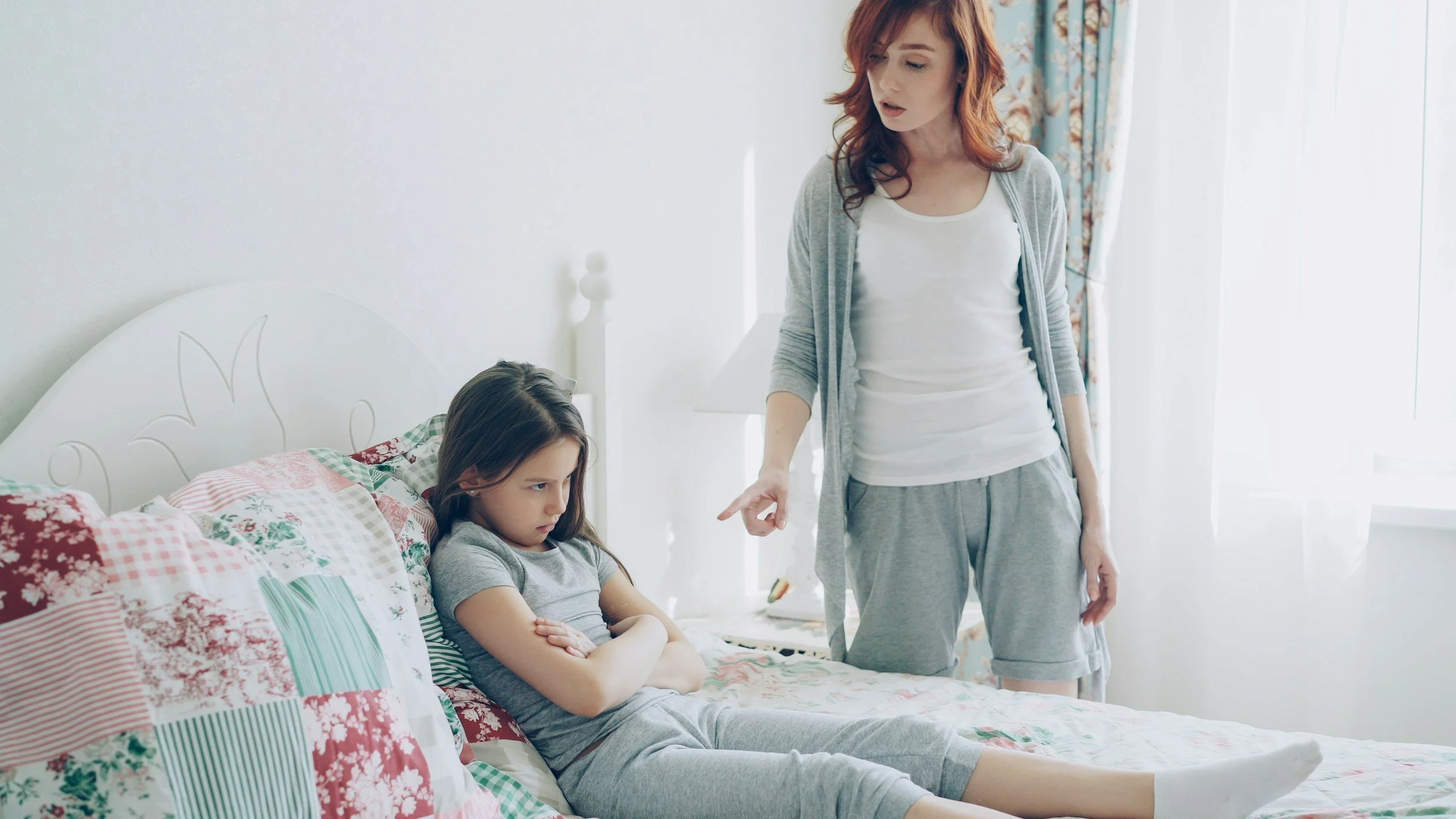
Authoritarian parenting style means a low warm parent and lack of connection with high obedience.
Authoritarian parenting is high on structure and low on warmth. The rules are strict, the expectations are high, and the explanation, when there is one, is often "because I said so." It's one of the four research-based parenting styles from Diana Baumrind's work and the Maccoby and Martin grid, sitting in the corner where demands are high and warmth runs low. Obedience is the goal, and connection takes a back seat.
What authoritarian parenting looks like day to day
Let’s say your child is having a meltdown over their blue-cup being in the dishwasher. The authoritarian response skips the feeling and goes straight to the rule: "Stop crying. You get what you get. Go to your room until you can act right." The limit is crystal clear, and the child is left alone with a big feeling and no help carrying it.
Authoritarian homes often run on threats, punishment and a strong sense of hierarchy, with little room for a child's input or a calm explanation of why a rule exists. The structure is real, and the warmth that would help a child accept it is thin.
Approaches that fall under authoritarian parenting
A couple of well-known approaches sit in or near the authoritarian corner:
Tiger parenting: popularized by Amy Chua in her 2011 book "Battle Hymn of the Tiger Mother," it runs on high demands, strict rules and a heavy focus on achievement. It can drive performance, and it tends to be light on the warmth-and-autonomy side.
Traditional or "old-school" strict parenting: many of us were raised with some version of this, where respect meant obedience and feelings stayed private. It lands in the authoritarian zone whenever the structure stays high and the warmth stays thin.
How authoritarian parenting compares to the other styles
The cleanest contrast is with authoritative parenting. Both keep the structure high, and they part ways on warmth: an authoritative parent explains, connects and stays responsive while holding a limit, and an authoritarian parent holds the limit and stops there. Permissive parenting sits at the near-opposite end, all warmth and few rules. You can see where all four land in our guide to the four parenting styles.
What the research says about authoritarian parenting
The research here is consistent. Children raised with authoritarian parenting tend to be obedient and capable, and they score lower on happiness, self-esteem and social skills than kids raised authoritatively. High control without warmth can teach a child to follow rules when an adult is watching, while leaving the self-regulation and confidence that come from understanding the why underdeveloped.
The Family Life Education take on authoritarian parenting
If you recognize your own parenting here, the encouraging news is that the shift is additive. You can keep the standards you've worked hard to set and add the warmth back: the named feeling, the one-sentence reason, the hand on the shoulder while the limit holds. A child needs the structure you're already good at, and they also need to feel you're on their side while you hold it, which starts with your own regulation and co-regulation.
In Happy Day Play's Grown-Up & Me classes, the steadiest and warmest grown-ups are often the ones with the clearest limits, because warmth and structure reinforce each other in real time.
If you'd like to practice adding warmth without losing your boundaries, Happy Day Play's Grown-Up & Me classes are walk-in, one price per family, with no commitment.
Key takeaways
- Authoritarian parenting is high on rules and structure and low on warmth, with obedience as the main goal.
- Research links it to obedient kids who score lower on happiness, self-esteem and social skills than children raised authoritatively.
- Tiger parenting and traditional strict parenting both sit in or near the authoritarian corner.
- Moving toward authoritative parenting is additive: keep the structure and add warmth, starting with your own regulation.
Sources & further reading 4
- Iowa State University Digital Press. (2020). Baumrind's parenting styles. Parenting and Family Diversity Issues. iastate.pressbooks.pub
- UCLA Center for Mental Health in Schools. Authoritarian vs. authoritative parenting. School Mental Health Project. smhp.psych.ucla.edu
- The Conversation. From tiger to free-range parents: what research says about pros and cons of popular parenting styles. The Conversation. theconversation.com
- ZERO TO THREE. Your calm is their calm: co-regulation strategies for infants and toddlers. ZERO TO THREE. zerotothree.org
About this article
Every article on Happy Day Play is written by Kaitlynn Blyth herself, then checked against our published standards before it goes live. You can read exactly how we research, verify, and fact-check our work, and how we use and limit AI, in the policies below.
Last fact-checked June 15, 2026
Read More About Parenting