Music Classes for Toddlers: The Real Benefits, Backed by Research
A family life educator on what toddler music and movement classes actually do for language, motor skills, self-regulation and bonding, plus how to pick a good one and keep the music going at home.
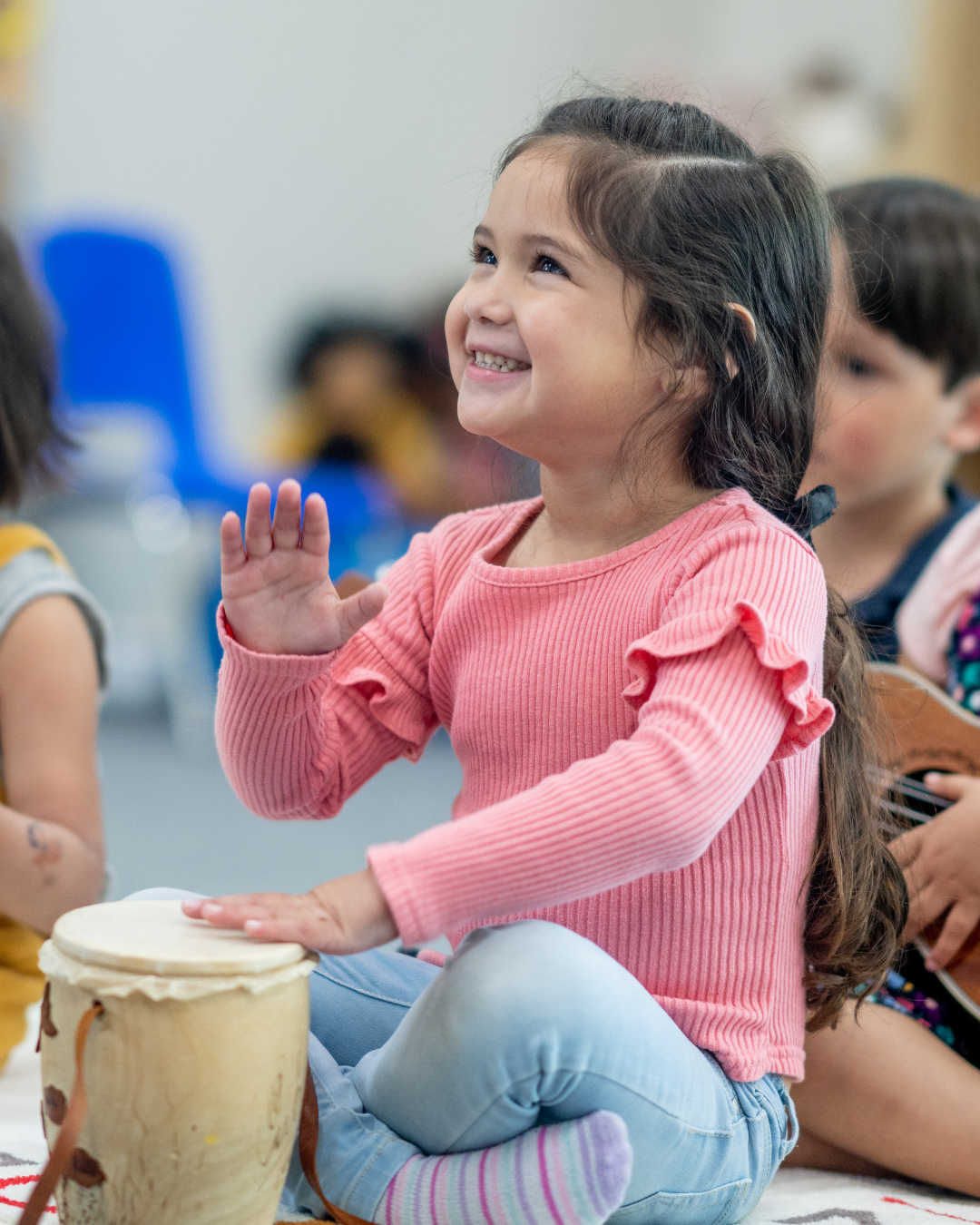
A good music class should be more than something to do during the week with your toddler.
You are standing in your kitchen, your toddler is banging a wooden spoon on a pot, and somewhere in the back of your tired brain you are wondering whether a music class would actually be worth it. Would your child get something out of it? Would you? Is this a real developmental tool or mostly a way to fill a weekday morning?
The short answer is yes, a good toddler music class is a real developmental tool. The fuller answer, which is what this guide is for, is that the benefits are bigger and quieter than most parents expect, and the kind of class you choose matters a lot.
We are a family life education company, so we think of music class as a guided practice that helps a whole family grow together, more than a simple activity. With that in mind, here is what the research says, what to look for in a class and how to keep the music going at home long after the last song of the morning.
What actually happens in a toddler music and movement class
If you have never been to one, a music and movement class is part circle time, part dance party, part early childhood lab. It usually runs 30 to 45 minutes, with a small group of children somewhere between newborn and 3 years old, each with a parent or caregiver in the room.
A typical music class flow for babies and toddlers
Most well-designed classes follow a predictable arc: a hello song to settle everyone, a few movement songs to wake up little bodies, an instrument exploration with shakers, rhythm sticks, scarves or simple drums, a slower middle section with a lap song or a story, a parachute or bubbles somewhere in the mix and a goodbye song to close. The structure repeats week to week, which is exactly what toddlers crave.
Why music and movement belong together at this age
A toddler does not separate hearing a beat from feeling it in their body. Their nervous system takes in music through wiggling, bouncing, clapping, swaying and crashing into things, and a good class honors that. You will see children moving the entire time, because that is how they learn music, and how music helps them learn everything else.
The research-backed benefits of music for toddlers
Here is the actual evidence, in plain language.
Language, vocabulary and early literacy
Music and language share a lot of neural territory in a developing brain. Songs slow speech down, stretch out vowel sounds and repeat phrases in ways that help a toddler tune in to the rhythm and structure of words. In a study of more than 3,000 Australian children, Williams and colleagues found that families who did more shared music at home when their children were 2 to 3 had children with slightly stronger attention, prosocial skills and numeracy at ages 4 to 5. The associations were small, and the study looked at everyday music in the home, so treat it as a helpful habit worth building and an encouraging sign for music-rich classes too.
Gross motor skills, balance and body awareness
Marching, stomping, swaying, jumping, freezing, tiptoeing and twirling are all on the menu in a good music class. Each one builds the vestibular system, your child's sense of balance, along with proprioception, the sense of where their body is in space, and the cross-body coordination they will later need for skipping, climbing and writing. Zero to Three describes music and movement as a rich, efficient way to support development across the first three years.
Self-regulation and emotional development
Here is where it gets interesting for any parent deep in the toddler years. Music gives your child practice with slowing down and speeding up, getting big and getting small, holding still and bursting into motion. That is regulation training, dressed up as fun. Over time, the same brain pathways that help a toddler freeze when the music stops are the ones that help them pause before grabbing a toy or wait one more minute for snack.
A landmark study by Gerry, Unrau and Trainor randomly assigned 6-month-olds to either an active music class, where the grown-up sang and played along, or a class where music simply played in the background. The babies in the active classes showed earlier and more sophisticated brain responses to music, stronger prelinguistic communication gestures, more smiling and less distress. The active ingredient was the shared, attentive participation between adult and child.
Parent and child bonding
Class is one of the few weekly hours where you can put the phone down, give your child your full attention and make singing and moving together your only job. That hour matters. NAEYC's position on developmentally appropriate practice treats warm, responsive interactions between adult and child as central to early learning. A music class, done well, is a structured invitation to give your toddler exactly that.
Social skills in a small group
Toddlers are famously bad at sharing, which is normal and developmentally appropriate. A music class offers a low-stakes, low-conflict version of being in a group. Your child sees other children waiting their turn for the shaker, hears their own name sung in a welcome song and watches another grown-up help their child through a hard moment. Little of this is taught out loud, and all of it sinks in.
When toddlers are ready for music class
A common worry sounds like, "Is my child too young, too old, too wiggly or too shy for this?" Usually the answer is none of the above.
Developmental signs your child is ready
Music class works for most children from birth on, with different formats for different ages. Between 6 months and 18 months though, you can expect your child to start really participating, mimicking simple motions, joining in on familiar refrains and showing strong opinions about favorite songs. Watch for a few signs of readiness:
Interest when you sing or when music plays at home: a turn of the head, a pause, a grin.
Pleasure in movement: bouncing, swaying, dancing.
Comfort being in a room with other children, even if they mostly observe at first.
What to expect if your toddler is shy or very active
A small, well-run class has room for both. A shy toddler often spends the first few weeks on a parent's lap, just watching, and then one day walks into the middle of the circle on their own. A very active toddler often runs laps around the room while absorbing every song. Both responses are completely normal, and a skilled instructor lets your child arrive at participation in their own way.
What to look for in a high-quality toddler music class
Music classes vary widely. Here is what separates a developmental experience from glorified entertainment.
Small group size and a consistent teacher
Look for groups of around 10 child-and-grown-up pairs or fewer, with the same teacher every week. Toddlers thrive on familiarity, so a familiar teacher in a familiar room is the difference between a child who falls apart and a child who runs toward the door.
Age-appropriate songs, tempos and instruments
Toddler-friendly music has clear, steady tempos (often slower than you would expect), simple melodies, lots of repetition and lyrics within reach. Instruments should be safe to mouth, small enough for little hands and varied enough to keep exploration interesting. A good class mixes simple originals with a few classics, which widens your child's musical world and connects the generations, while keeping the foundational elements strong.
Predictable structure with room for child-led moments
A great class has a strong skeleton, a hello song, clear transition cues and a goodbye song, plus flexibility in the middle. The teacher should follow the children's energy, slow down when the room needs it and let a child have a moment of their own with ease.
Live music over recorded tracks
Live music wins almost every time at this age. A teacher with a guitar or ukulele can adjust tempo, key and volume in real time to match the room. Recorded music makes a fine accent, and a live human can notice your toddler starting to melt down and soften the song in the moment.
A real role for the grown-up in the room
This is the test most franchise programs fail. In a strong class, you are the most important learner in the room, coached in real time. You learn songs you can sing on the drive home. You hear the teacher narrate your child's behavior in a way that hands you a new lens. You leave with something to use the next day.
The family life education layer most classes miss
Almost every toddler music program will tell you the class is good for your child. Far fewer build the class to support you, the grown-up, at the same time.
How a skilled instructor coaches the parent
In a family life education class, the teacher reads two people at once, your child and you. When your toddler refuses the parachute, the teacher offers you a calm model, a phrase you can borrow and a way of being with a hard moment that you can take home. You walk out with new tools and the memories.
Carrying class rituals into the rest of your week
The cleanup song from class can become the same song you sing at home before lunch. The lap song that calms your toddler in circle time can become a bedtime ritual. The class is a 45-minute laboratory, and the rest of your week is where the real magic happens.
Easy ways to keep the music going at home
You do not need a degree, a piano or a curated playlist. You need your voice and a little willingness to sound silly. Infants are wired for this from the start, since research shows babies are sensitive to pitch and rhythm and respond to the sing-song quality of a caregiver's voice well before they talk.
Three-minute rhythm activities for everyday routines
Tap a steady beat on your child's back during a hug.
Clap the syllables of family members' names while you walk to the car.
Sing the same "we are going to put on our shoes" song every time, until your toddler sings it back to you.
Songs that help with transitions, meals and bedtime
Choose one short song for each major daily transition and use it every time: a wake-up song, a meal song, a bath song, a goodbye song when a parent leaves for work. Toddlers thrive on predictable cues, and music is the gentlest cue we have.
Toddler music class questions parents ask
My toddler never sits still. Will class still work?
Yes. A good toddler music class does not require sitting still, because the whole point is movement. A child running laps while singing the chorus is participating fully. A child who spends 30 minutes by the bookshelf and joins only for the goodbye song is participating fully. Trust the process, and you will be surprised by what they learn, and what you learn too.
What if my child refuses to participate?
Watching is participating. Listening is participating. Being in the room is participating. Some children take several classes to feel safe enough to join the circle, and that is the class doing its job. At Happy Day Play, children tend to warm up fairly quickly, and wherever you go, it helps to know that settling in can take time.
How often should we attend?
Once a week is plenty for most families, especially paired with simple music play at home. The real learning happens between classes, in the songs, phrases and little actions you carry home.
If this is the kind of music class you have been picturing, we would love to meet you and your toddler. Our Grown-Up & Me music and movement classes are built around the exact principles in this article, with a family life educator in the room every week. We welcome wiggly toddlers, slow-to-warm toddlers and the grown-ups who love them. Classes are walk-in, one price per family, with no long contract or registration fee, so you can try one and see how it feels. Come see what 45 minutes of intentional music time can do for your whole family.
Key takeaways
- A good toddler music class supports language, motor skills, self-regulation, bonding and early social skills, all through movement and play.
- The active ingredient is you. In a landmark study, babies in active classes where the grown-up sang along showed stronger communication and more smiling than babies who just heard music play.
- Choose a class with a small group, a consistent teacher, live music, age-appropriate songs and a real role for the grown-up.
- The learning continues at home. A handful of simple songs for daily transitions does as much as the class itself.
Sources & further reading 6
- Gerry, D., Unrau, A., & Trainor, L. J. (2012). Active music classes in infancy enhance musical, communicative and social development. Developmental Science, 15(3), 398 to 407. Read the study
- Williams, K. E., Barrett, M. S., Welch, G. F., Abad, V., & Broughton, M. (2015). Associations between early shared music activities in the home and later child outcomes. Early Childhood Research Quarterly, 31, 113 to 124. Read the study
- Trehub, S. E. (2003). The developmental origins of musicality. Nature Neuroscience, 6(7), 669 to 673. Read the paper
- Zero to Three. Beyond Twinkle, Twinkle: Using music with infants and toddlers. ZeroToThree.org. Read the resource
- NAEYC. Developmentally Appropriate Practice (DAP) position statement. National Association for the Education of Young Children. Read the statement
- American Academy of Pediatrics. Developmental milestones: 2 year olds. HealthyChildren.org. Read the guidance
About this article
Every article on Happy Day Play is written by Kaitlynn Blyth herself, then checked against our published standards before it goes live. You can read exactly how we research, verify, and fact-check our work, and how we use and limit AI, in the policies below.
Last fact-checked June 13, 2026