2-Month-Old Baby Development: What Your Baby Already Understands According to a 2026 Infant Brain Study
New brain research shows 2-month-old babies already sort what they see into categories like animals, toys and food. Here's what that means for your baby's development, the milestones to expect at 2 months and simple ways to talk, show and play during everyday care.

A 2026 study using brain scans of awake babies found that 2-month-olds already sort the things they see into meaningful groups, much earlier than scientists expected.
At 2 months, your baby's day can look like a loop of feeding, sleeping and fussing. Behind those wide eyes, a lot more is happening. A 2026 study using brain scans of awake babies found that 2-month-olds already sort the things they see into meaningful groups, much earlier than scientists expected.
That's a good reason to keep talking, pointing and showing your baby the world, even when it feels like a one-sided conversation.
What the 2026 infant brain study found
Researchers at Trinity College Dublin scanned the brains of 130 two-month-old babies using awake functional MRI, according to the university's announcement. Babies lay on a beanbag wearing sound-canceling headphones and looked at colorful pictures for 15 to 20 minutes.
The images came from 12 familiar categories, including cats, birds, rubber ducks, food, shopping carts and trees. The study, published in Nature Neuroscience, found that the visual part of the babies' brains was already grouping the images by category. A computer model of vision matched the babies' brain patterns, which suggests babies learn these groupings from what they see.
The team describes it as the largest long-term study of its kind in awake infants, and they rescanned the same babies at 9 months.
What your 2-month-old can see and hear
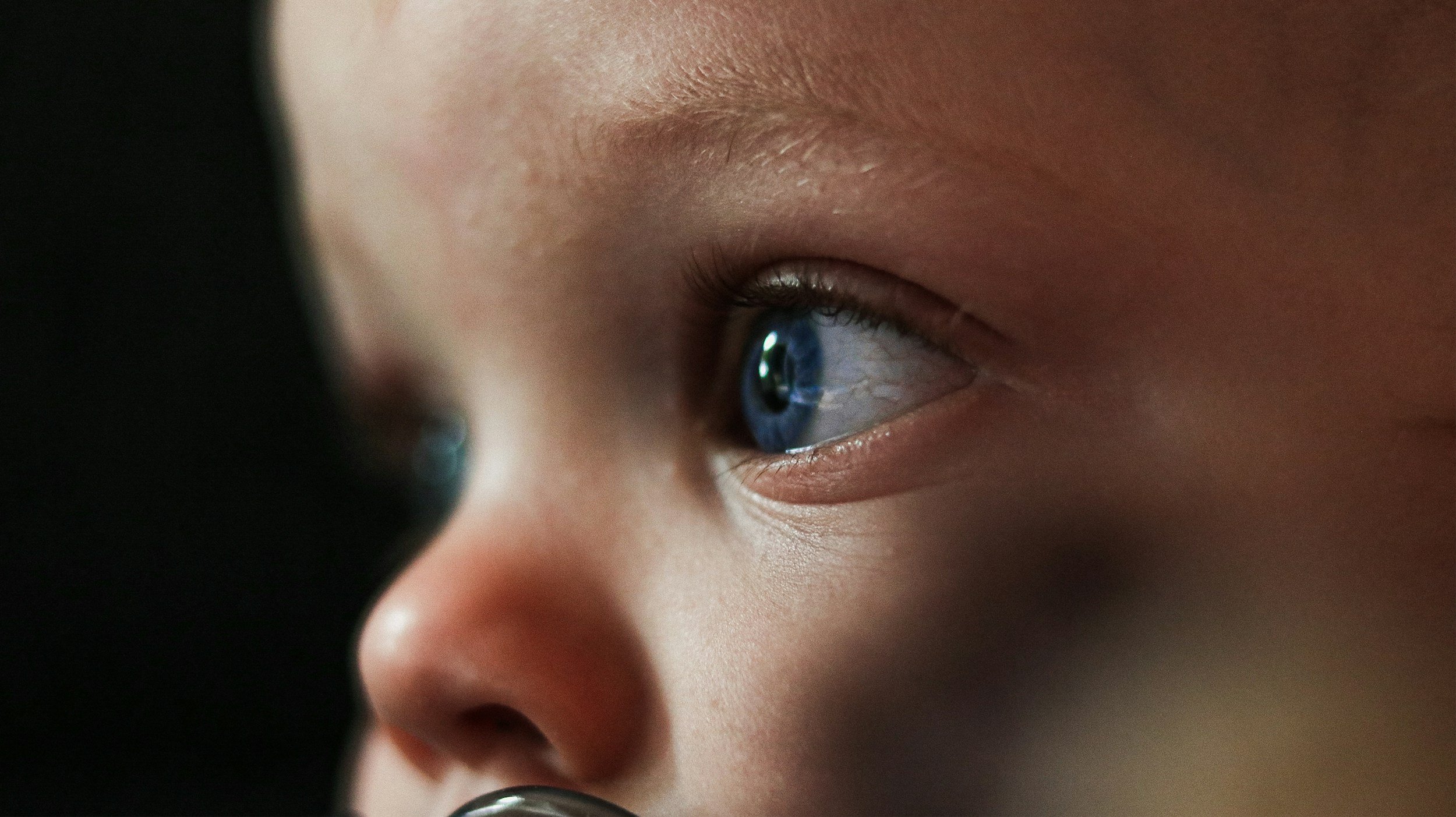
Your baby's vision is still developing. The American Academy of Pediatrics explains that young babies see most clearly about 8 to 12 inches away, about the distance to your face during a feeding. Eyes may wander or cross as they learn to work together, and that should settle by about 2 to 3 months.
The AAP also notes that young babies prefer high-contrast patterns and human faces. Their hearing is fully mature, and they may turn toward familiar voices.
2-month milestones to watch for
The CDC lists these milestones by 2 months:
Social: Your baby calms when spoken to or picked up, looks at your face and smiles when you talk or smile.
Language: Your baby makes sounds other than crying and reacts to loud sounds.
Thinking: Your baby watches you as you move and looks at a toy for several seconds.
Movement: Your baby holds up their head during tummy time, moves both arms and legs and briefly opens their hands.
Please note that every baby develops at their own pace and all listed milestones are calculated by using a wide range compiling commonalities based on averages. If you have questions about your baby's development, bring them to your pediatrician.
Simple ways to support your baby's learning
You don't need flashcards or special programs. Your baby learns from you during everyday care:
Name what you see: On a walk, say, "Look, a dog! That's a big brown dog."
Get close: Hold your face or a toy 8 to 12 inches from your baby so they can see it clearly.
Use high-contrast items: Black-and-white board books and patterned cloths catch young eyes.
Talk in parentese: ZERO TO THREE explains that babies prefer the high-pitched, sing-song speech adults use naturally with babies.
Pause and wait: After you speak, give your baby time to coo, smile or wiggle in response.
That pause matters. Harvard's Center on the Developing Child calls these exchanges serve and return. When your baby makes a sound or a face and you respond, you help build the brain connections behind language and social skills.
Following your baby's cues
Babies this age tire quickly. When your baby turns away, arches, fusses or looks glassy, they're telling you they've had enough. Let them rest and try again later. Short, warm moments throughout the day add up.
Evenings can be especially hard at this age. If fussiness peaks around dinnertime, our article on the baby witching hour explains why. If nights are a struggle, read about newborn day-night confusion.
Music, signs and connection at Happy Day Play
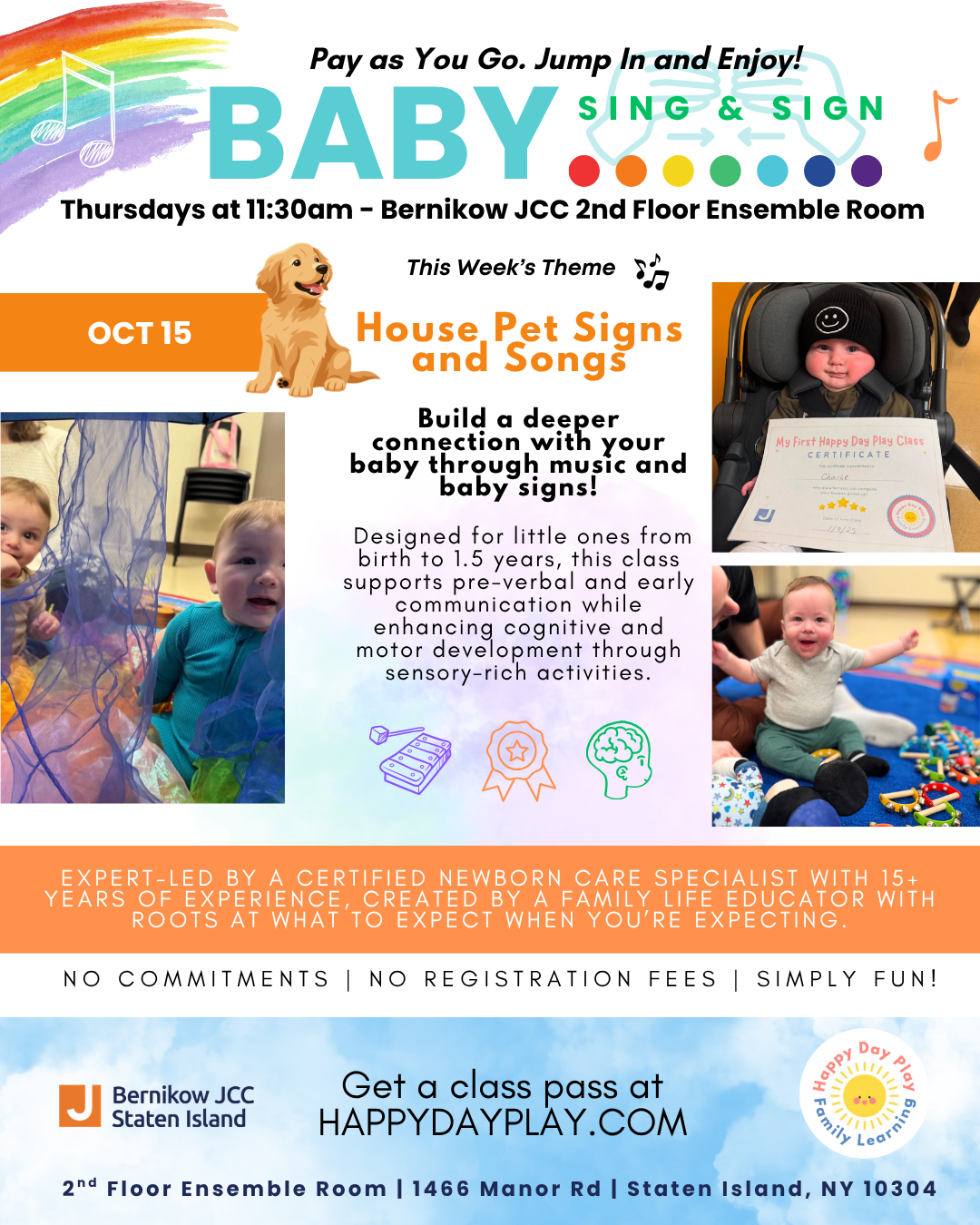
Singing, gentle movement and face-to-face play are built into our baby classes. Baby Sing & Sign and our Grown-Up & Me classes give you songs and simple signs to use at home, plus time with other parents of little ones. Walk-in classes are one price per family, with no commitment, and siblings are included.
Key takeaways
- A 2026 brain imaging study of 130 two-month-olds found their brains already sort what they see into categories like animals, toys and food.
- At 2 months, babies see most clearly at 8 to 12 inches and prefer faces and high-contrast patterns.
- CDC milestones at 2 months include smiling when you smile, cooing and holding up their head during tummy time.
- Naming things, talking in parentese and pausing for your baby's response all support early learning.
Sources & further reading 7
- O'Doherty, C., Dineen, Á. T., Truzzi, A., et al. (2026). Infants have rich visual categories in ventrotemporal cortex at 2 months of age. Nature Neuroscience, 29(3), 693-702. Read the study
- Trinity College Dublin. (2026, Feb. 3). "I see a rubber duck": Babies categorise objects in the brain at just two months old. Trinity College Dublin News. Read the news release
- Centers for Disease Control and Prevention. Milestones by 2 months. Learn the Signs. Act Early. Read the milestones
- American Academy of Pediatrics. (2024). Infant vision development: What can babies see? HealthyChildren.org. Read the article
- American Academy of Pediatrics. (2026). Developmental milestones at 1 month old. HealthyChildren.org. Read the article
- Benderev, M. D. (2022, April 29). Let's talk about it: 5 ways to build babies' language and communication skills from birth. ZERO TO THREE. Read the article
- Center on the Developing Child at Harvard University. Serve and return. Harvard University. Read the key concept
About this article
Every article on Happy Day Play is written by Kaitlynn Blyth herself, then checked against our published standards before it goes live. You can read exactly how we research, verify, and fact-check our work, and how we use and limit AI, in the policies below.
Last fact-checked Oct. 8, 2026
Read More About Baby