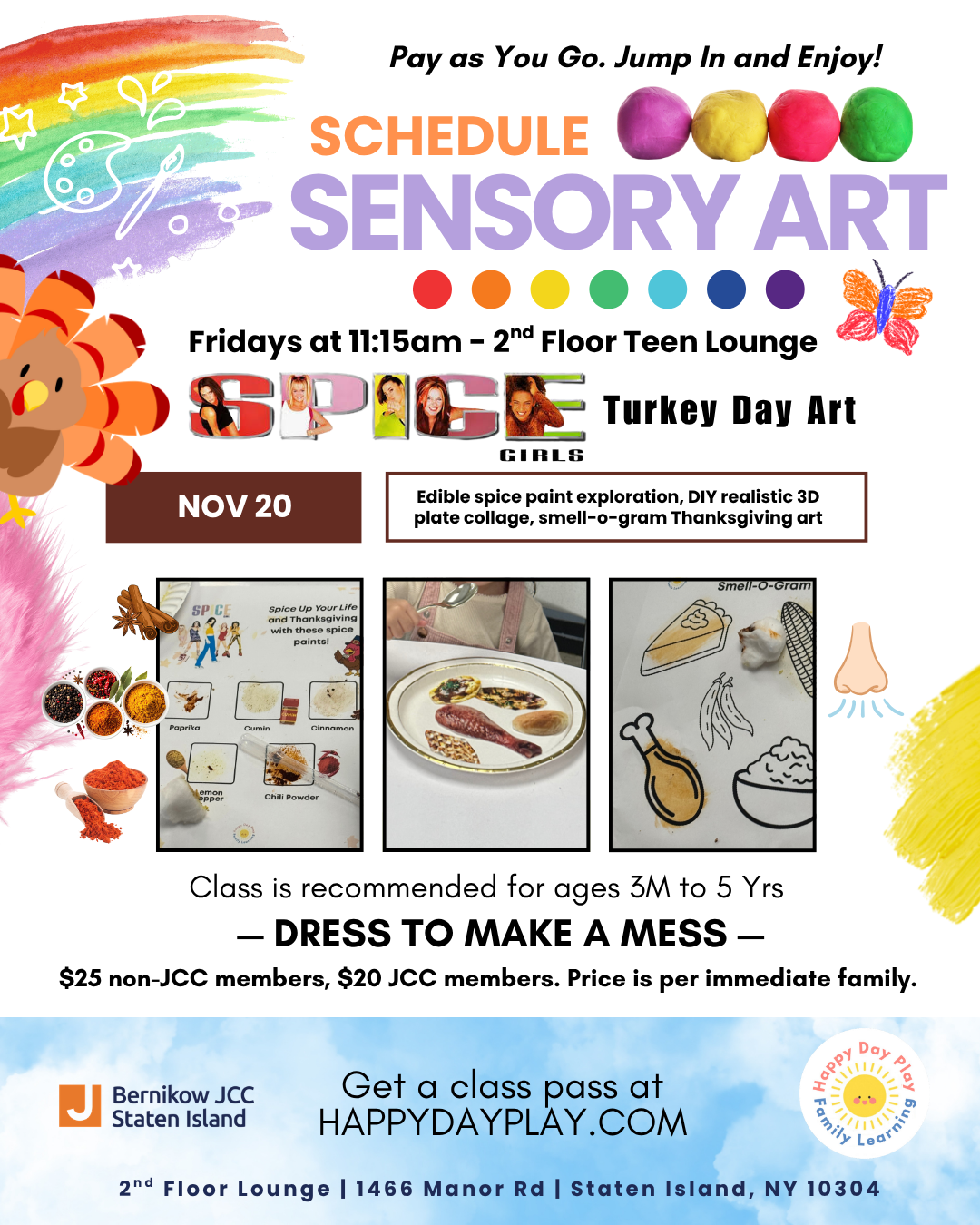
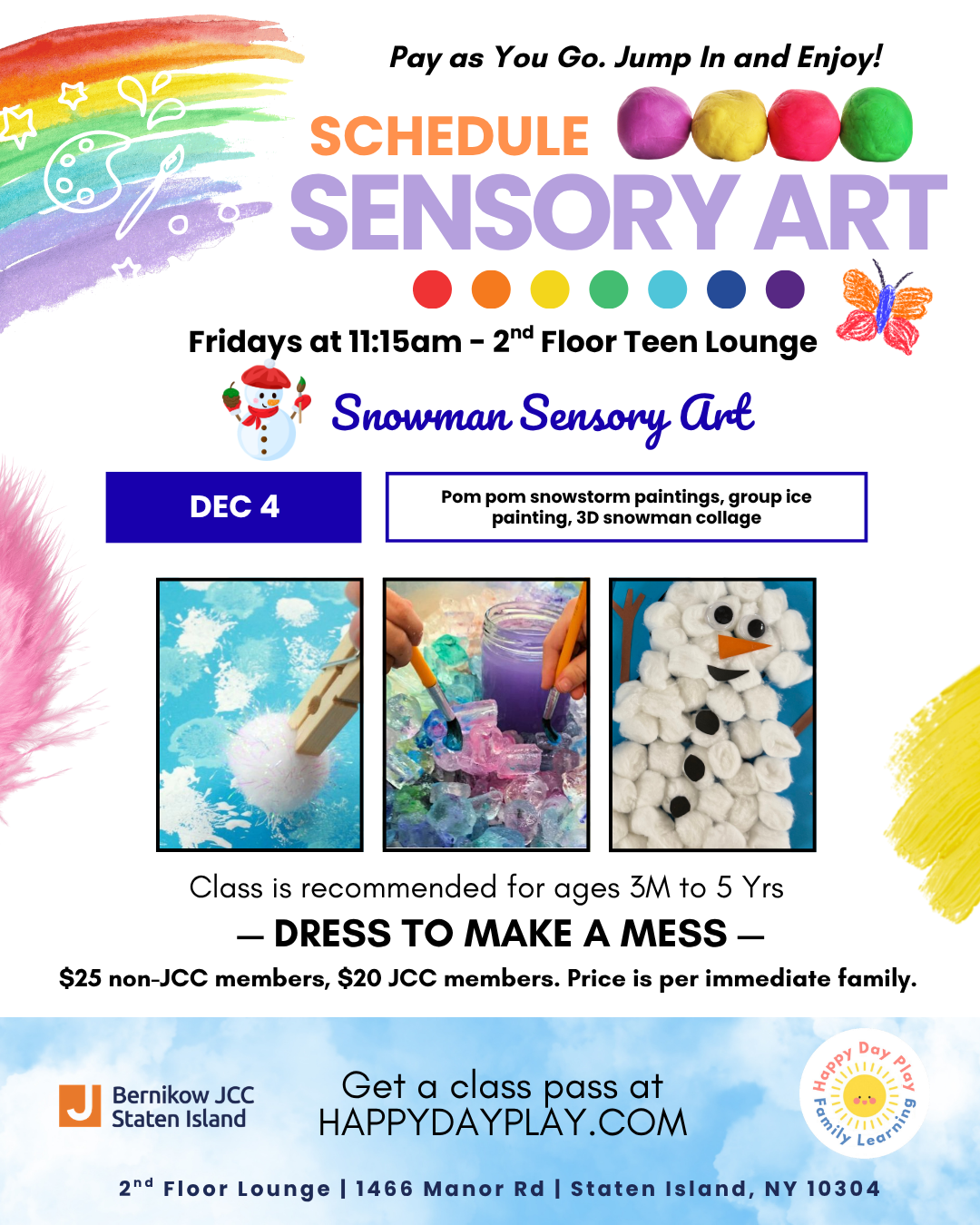
What Is Sensory Art for Babies and Toddlers: How It Supports Development
Sensory art lets babies and toddlers explore paint, texture and color with their whole bodies, and the open-ended, process-first kind does real developmental work. Here's what your child builds when they squish and smear, plus simple ways to set it up at home after a Happy Day Play class.
What is sensory art and how does it differ from traditional arts and crafts?
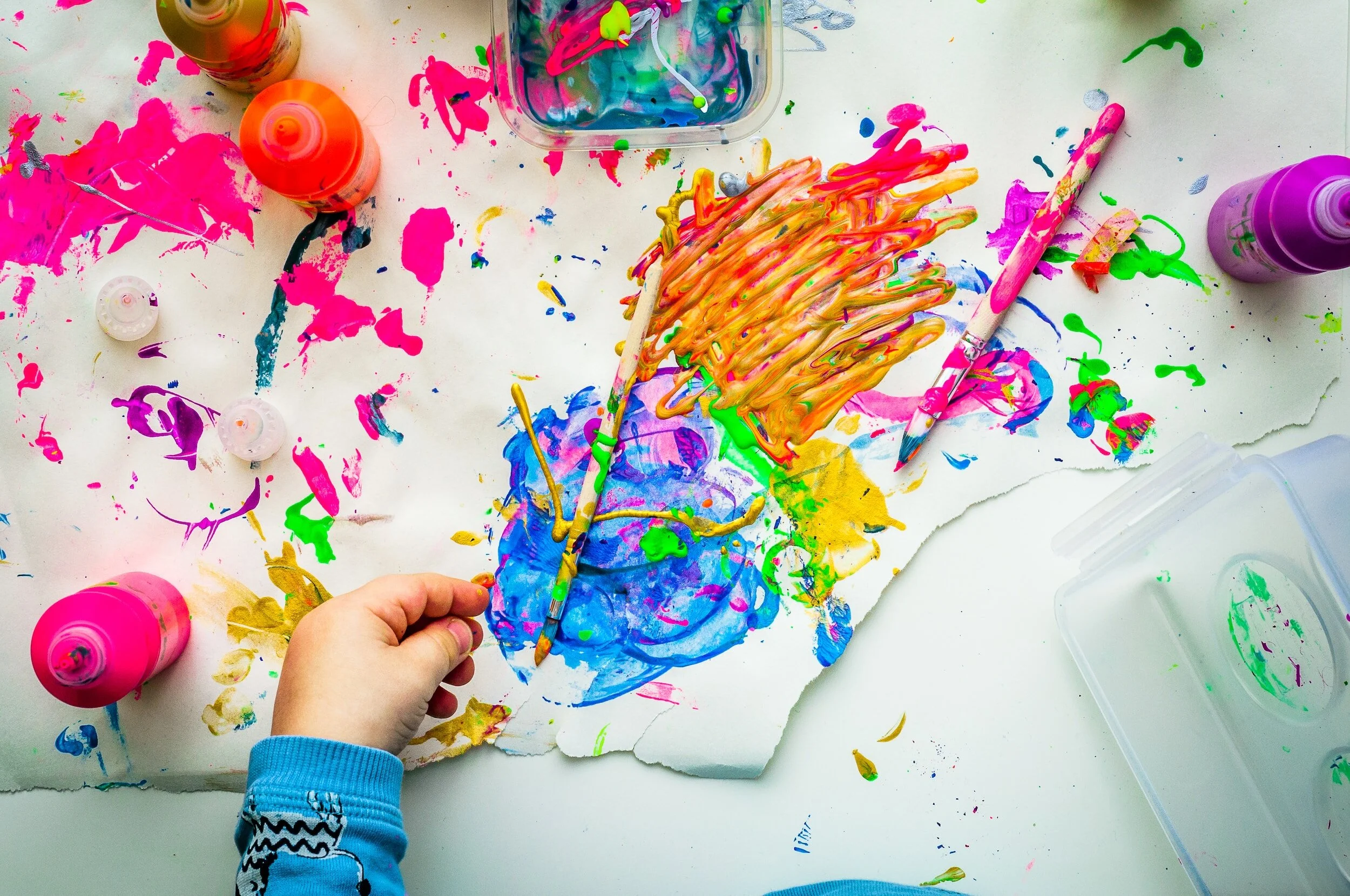
Picture your 1-year-old at the table with a blob of thick paint in front of her. She pats it and may stare at it. She drags one finger through, lifts her hand and studies the streak she made. No picture, no plan, and that's exactly right.
Sensory art is open-ended art that puts the experience first. Children explore paint, dough, water, foam and texture with their hands and bodies, and the doing matters more than any finished piece for the fridge. The National Association for the Education of Young Children calls this process art, where there's no sample to copy and no single right way to create, so your child gets to lead.
A craft is different, and we love those too. A craft has a target, like gluing the cotton ball where the sheep's body goes. Process art hands your child the materials and lets them discover what those materials do. Both process art and crafts belong in childhood. For babies and toddlers, the open-ended kind carries most of the developmental weight, because exploration is their main work right now.
What sensory art builds, from babies to toddlers
Play is how young brains do their heaviest building. The American Academy of Pediatrics' 2018 clinical report The Power of Play, reaffirmed in 2025, describes how play shapes brain structure and function and strengthens executive function, the mental control center behind focus, planning and self-regulation. Sensory art is that kind of play with paint on your hands.
Here's what your child is building, from the first year up:
Fine motor and hand strength: Pinching a sponge, squeezing a glue bottle and pulling fingers through foam develop the small hand muscles your child will later use to hold a crayon and, eventually, a pencil.
Cause-and-effect thinking: Zero to Three points out that babies learn largely through their senses, using their eyes, hands and mouths as tools. When your baby smacks a paint-covered tray and the color splatters, she's learning that her actions change what's around her.
Language: Narrate what's happening and the words start to stick. Try "It feels cold," "Your hands are so sticky" or "You want more red." Sensory art hands you a steady supply of real, right-now words to say.
Social and emotional skills: Squishing dough is a release valve. A toddler who can't yet say "I'm frustrated" can pound, smear and stamp instead, and feel steadier afterward. Sitting next to another child at the same tray is early practice at sharing space.
The grown-up is part of the material list
Most baby and toddler art classes aim everything at the child and treat the grown-up as a spectator. That misses half of what makes the experience work. Family Life Education, the framework behind every Happy Day Play class, builds the caregiver into the learning.
The science is on this side. The Harvard Center on the Developing Child describes serve and return, the back-and-forth between a child and a warm adult that shapes brain architecture. Your child reaches out with a babble, a glance or a painted handprint, you answer, and that volley wires the connections behind language and social skills.
Your part is small and powerful. Get down to your child's level. Follow what already has their attention rather than steering them. Put words to it, something like "You pressed so hard the paint squished out." You don't have to make anything yourself. In sensory art, you're part of the material list, the warm and responsive thing your child keeps checking back with as they explore.
How to set up sensory art at home
You can start with what's already in your kitchen. A few ground rules keep it manageable:
Contain the mess: A washable mat, an old shower curtain or a high-chair tray turns "everywhere" into "this one spot." Old clothes or a bare diaper for babies saves you the laundry stress.
Go taste-safe for the littlest ones: Babies mouth everything, so reach for edible paint like plain yogurt tinted with a drop of food coloring, or a thick mix of cornstarch and water. Stay within arm's reach the whole time.
Offer texture instead of instructions: Put out one or two materials and let your child lead. Think cooked spaghetti, shaving cream, dry oats or a sponge and a bowl of water. Skip the demonstration of the "right" way.
Keep it short: Ten minutes of real exploration beats an hour you both dread cleaning up. Stop while it's still fun.
For more ways to fold open-ended creativity into ordinary days, read our guide to creative play for families.
What to look for in a sensory art class
A good sensory art class gives your family what a kitchen session can't always manage: fresh materials every week, a space someone else cleans up and a few other families to share it with. As you compare options, look for:
A focus on process: Weekly themes are great, and the activities should still leave room for your child to explore rather than turn out one identical craft.
Real developmental grounding: Ask whether the class is built on early childhood development, and whether the person leading it can speak to your child's stage.
Caregivers genuinely included: The strongest classes welcome any grown-up, whether that's mom, dad, a grandparent, a nanny or an aunt, and they build the adult's role right into the activity.
Clear, upfront pricing: Be cautious of programs that pull you in with a free class and then press you toward a long contract or a steep registration fee, sometimes with a little guilt attached. Transparent pricing is a green flag.
Key takeaways
- Sensory art is open-ended, process-first art: Babies and toddlers explore paint, texture and color with their hands, and the experience matters more than any finished piece.
- It builds real skills: Squishing, pinching and smearing develop fine motor strength, cause-and-effect thinking, language and early social-emotional skills.
- Your role matters as much as the materials: Sitting at your child's level and narrating their discoveries turns art time into brain-building back-and-forth.
- You can start at home today: A washable mat, taste-safe paint and 10 minutes of free exploration are enough to begin.
Sources & further reading 4
- Bongiorno, L. (2014). The benefits of process-focused art experiences for preschoolers. Teaching Young Children, National Association for the Education of Young Children. naeyc.org
- Yogman, M., Garner, A., Hutchinson, J., Hirsh-Pasek, K., & Golinkoff, R. M. (2018, reaffirmed 2025). The Power of Play: A Pediatric Role in Enhancing Development in Young Children. Pediatrics, American Academy of Pediatrics. publications.aap.org
- Zero to Three. (2024). Learning Through Play: Birth to 12 Months. zerotothree.org
- Center on the Developing Child at Harvard University. Serve and Return. developingchild.harvard.edu
About this article
Every article on Happy Day Play is written by Kaitlynn Blyth herself, then checked against our published standards before it goes live. You can read exactly how we research, verify, and fact-check our work, and how we use and limit AI, in the policies below.
Last fact-checked June 22, 2026
Read More About Art and Sensory Play